Senenmut's Ceiling
Mapping the Ancient Egyptian Sky
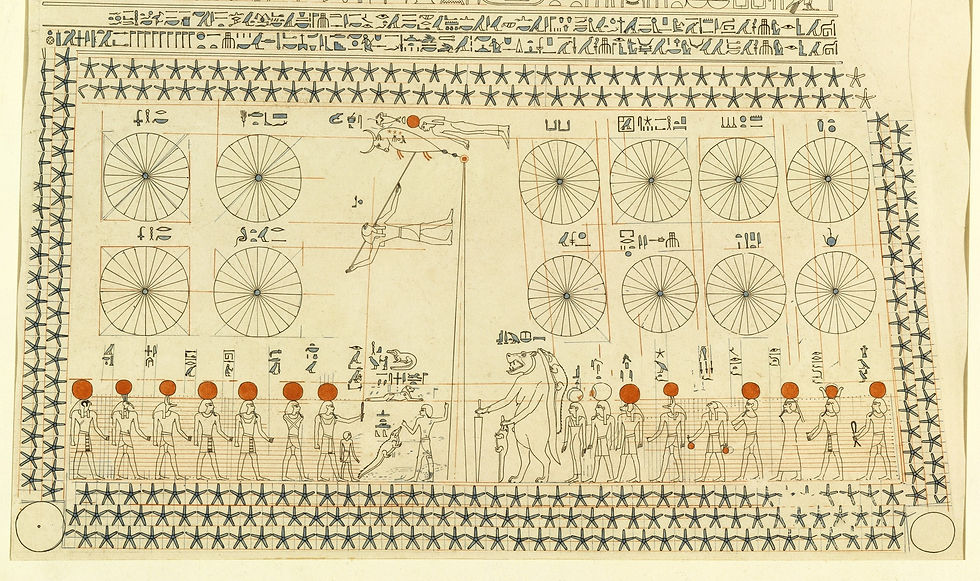
The astronomical ceiling in Senenmut's tomb (TT353) is the earliest known surviving Egyptian astronomical ceiling. Its two panels represent the northern and southern areas of the sky. The southern panel contains decans (groups of stars used to mark the hours of the night), as well as constellations and planets. Jupiter, Saturn, Mercury, and Venus appear. Mars is missing, although it appears on later astronomical ceilings.
The decans first appeared during the Middle Kingdom on diagonal star clocks. There were 36 groups, with particular decans marking the hours of the night over successive ten-day periods, each equivalent to one Egyptian week. By the New Kingdom, these star calendars had developed into elaborate astronomical ceilings.
Painted inside a tomb, Senenmut's ceiling brought the heavens into a space associated with death and the afterlife. Scholars have also debated whether some of its astronomical features encode a specific date, suggesting that the ceiling might represent the sky on a particular night.